Best overall: Downtown Tempe. Best for campus access: University Park. Best for a residential walking routine: Mitchell Park. This 2026 guide to the best walkable neighborhoods in Tempe AZ compares seven areas by the destinations you can reach on foot—not just how attractive the streets look.
- Downtown Tempe leads the best walkable neighborhoods in Tempe AZ for dining, campus access, and transit connections.
- University Park suits campus-focused buyers; Maple-Ash suits buyers who want residential streets near Mill Avenue.
- Mitchell Park, Riverside, Daley Park, and Broadmor offer different compromises between destinations and residential surroundings.
- Thenurserealtoraz helps East Valley homebuyers and relocating medical professionals compare neighborhoods and housing options.
Why this matters
A walkable neighborhood is useful only when its walking routes serve your actual routine. Restaurants nearby do not solve a grocery trip, and a short route on a map does not show how an intersection feels on foot.
Thenurserealtoraz is a real estate brokerage serving East Valley buyers, sellers, and relocating medical professionals. Use Thenurserealtoraz to discuss your housing search, then assess each candidate address against the destinations you use regularly.
For a 2026 home search, rank the route before the property. Tempe's summer heat makes shade, crossing conditions, and the timing of your walks central to that decision. Walkability does not mean every trip should happen on foot.
What makes the best walkable neighborhood in Tempe?
These criteria put practical access ahead of neighborhood reputation:
- Daily destinations: Identify groceries, food, errands, and recreation you would actually use.
- Crossing conditions: Check signals, driveway entrances, and major-road crossings along the complete route.
- Shade and exposure: Look at the sidewalk itself, not trees visible elsewhere on the block.
- Transit access: Distinguish reaching a stop from having a useful connection to your destination.
- Residential fit: Assess street activity, property type, and the immediate surroundings of the home.
Test a 10-minute walk from each shortlisted address. Select 3 destinations that matter to you, then compare 2 routes where alternatives exist. These are search exercises, not measured travel times or neighborhood scores.
The seven neighborhoods at a glance
| Rank | Neighborhood | Best for | Standout walking asset | Key limitation |
|---|---|---|---|---|
| 1 | Downtown Tempe | The broadest urban walking routine | Mill Avenue, ASU, and transit access | Activity and exposure vary by block |
| 2 | Maple-Ash | Residential streets near downtown | Proximity to Mill Avenue and campus | Nearby destinations still require route checks |
| 3 | University Park | Campus-centered daily life | Access toward ASU's Tempe campus | Campus access is not a complete errands network |
| 4 | Mitchell Park | Park-centered residential walking | Mitchell Park and neighborhood streets | Shops and transit depend on the address |
| 5 | Riverside | Lake-oriented recreation | Routes toward Tempe Town Lake | Recreational access is not grocery access |
| 6 | Daley Park | Park walks and southern campus access | Daley Park and College Avenue | Arterial crossings affect longer walks |
| 7 | Broadmor | Residential walks south of campus | Neighborhood streets near central Tempe | Less direct access to downtown destinations |
These areas are not interchangeable. Downtown emphasizes destinations; the residential neighborhoods require a closer match between your front door and your specific routine.
1. Downtown Tempe: best for an urban walking routine
Downtown Tempe ranks first because Mill Avenue, Arizona State University's Tempe campus, and transit connections give you several reasons to walk in the same area. It is the clearest starting point when dining, campus trips, and downtown activities matter more than a secluded residential setting.
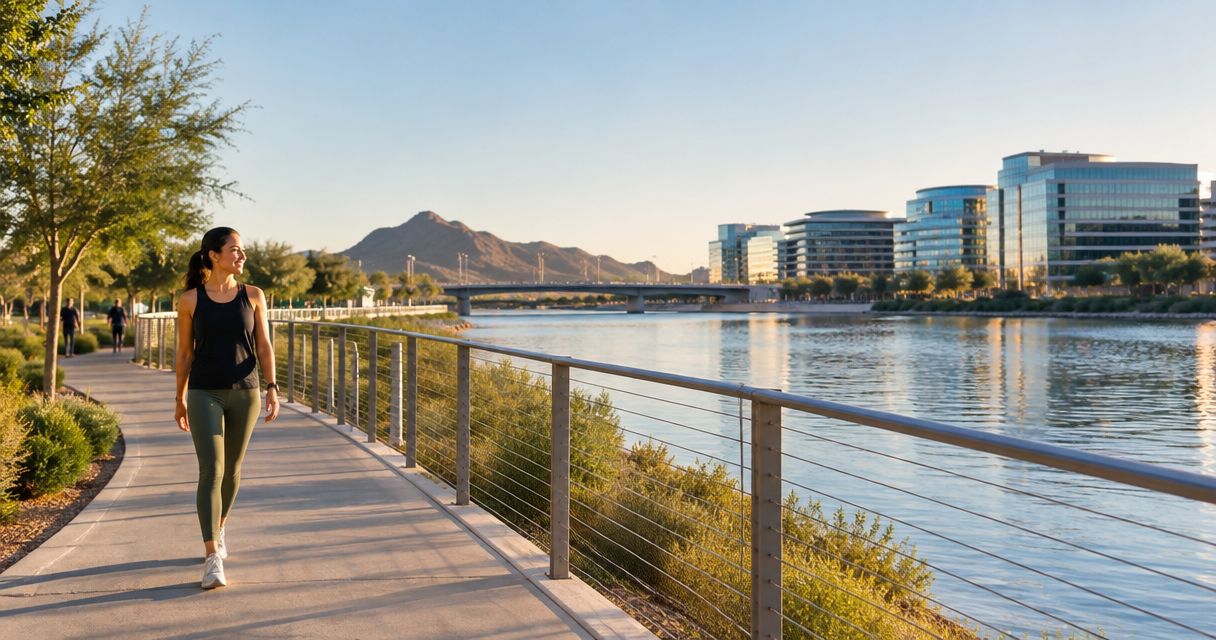
Tempe Town Lake adds a separate recreational destination north of the downtown core. Do not treat access to the lake as proof that every practical errand is equally convenient.
Downtown Tempe pros:
- Dining and downtown destinations support repeat walking trips.
- Campus access gives walking a practical purpose beyond recreation.
- Light rail and streetcar provide options for extending a trip beyond walking distance.
Downtown Tempe cons:
- Events and nightlife create activity that does not suit every buyer.
- Wide roads, intersections, and exposed stretches still need inspection.
For your 2026 shortlist, start with the building entrance rather than a pin centered on Mill Avenue. Check the walk home as carefully as the outward trip, including the crossing you will use after dinner or a campus event.
Best for: Buyers who want several urban destinations within their walking routine.
Verdict: Buy in Downtown Tempe if destination access outweighs your preference for a quieter setting.
2. Maple-Ash: best for residential streets near downtown
Maple-Ash sits near downtown and ASU, giving buyers a way to compare residential surroundings with access toward Mill Avenue. Its appeal is the combination—not a claim that every home offers the same walk.
A property closer to your preferred destination can produce a different daily routine from another home carrying the same neighborhood label. Follow the actual sidewalk connections before deciding that proximity on a map is enough.
Maple-Ash pros:
- Residential streets provide an alternative to living directly in the downtown core.
- Nearby downtown and campus destinations give walks a purpose.
- The area lets you compare individual homes against an urban-access goal.
Maple-Ash cons:
- Proximity to active areas does not guarantee quiet at a particular address.
- Shade, sidewalk continuity, and crossings vary along your chosen route.
Inspect the home and the walk separately. A property can fit your housing needs while its route to groceries or transit fails your daily-life test. That distinction matters more than a broad reputation for charm or walkability.
Best for: Buyers who want residential streets with access toward downtown.
Verdict: Buy in Maple-Ash when the specific route delivers the downtown access you want.
3. University Park: best for campus-centered daily life
University Park belongs on the shortlist when ASU's Tempe campus is a recurring destination. Campus-oriented access is a distinct use case: your priority is reaching the part of campus you use, not simply reaching its edge.
Map the destination building and the return route. A campus boundary can make an address look convenient while leaving a substantial walk inside campus still to complete.
University Park pros:
- Campus proximity supports a destination-specific home search.
- Residential surroundings offer a different setting from the downtown core.
- Walking toward campus can connect several parts of a campus-centered routine.
University Park cons:
- Campus convenience does not establish convenient grocery access.
- The route to your particular building matters more than general proximity to ASU.
For a 2026 purchase, distinguish a campus-focused schedule from an off-campus work schedule. If your recurring destination changes, the advantage of this location changes with it. Choose the home for your current needs without assuming that one convenient trip solves every other trip.
Best for: Buyers whose regular activities center on ASU's Tempe campus.
Verdict: Buy in University Park for a verified campus route; hold if your routine is mainly elsewhere.
4. Mitchell Park: best for park-centered residential walking
Mitchell Park is a useful alternative when your definition of walkability starts with neighborhood walks and access to a park. It offers a different search angle from downtown: evaluate the residential route first, then test connections to errands and transit.
The park is a clear destination. It does not establish that every home in the surrounding neighborhood has an equally useful daily walking network.
Mitchell Park pros:
- Mitchell Park gives neighborhood walks a specific destination.
- Residential streets suit buyers seeking a different setting from Mill Avenue.
- An address-level search lets you balance park access with other needs.
Mitchell Park cons:
- Access to shops depends on the property's location and the route.
- A comfortable park walk does not prove a comfortable commute or grocery trip.
Visit from the exact home you are considering, not just from the park entrance. Note where the route crosses traffic, where shade ends, and whether the return feels equally practical. Separate the appeal of the park from the usefulness of the complete route.
Best for: Buyers who prioritize a park-centered residential walking routine.
Verdict: Buy in Mitchell Park when residential and park walks matter more than doorstep dining.
5. Riverside: best for lake-oriented recreation
Riverside, west of downtown, deserves consideration when walking toward Tempe Town Lake is a priority. Its position gives you a different way to evaluate access to the lake and downtown without treating them as the same destination.
Start with the route connecting the candidate property to the lake. Then run a separate test for errands; a good recreational connection does not automatically support a low-car daily routine.
Riverside pros:
- Tempe Town Lake provides a defined recreational destination.
- Downtown proximity gives you another route to evaluate.
- The location suits a search centered on walking outdoors rather than campus access alone.
Riverside cons:
- Routes toward recreation and routes toward shops serve different needs.
- Exposed stretches and major-road crossings affect the usefulness of a walk.
Your 2026 decision should distinguish occasional outings from trips you will repeat frequently. Walk the connecting streets as well as the destination path. The section between your front door and the recreational route is part of the experience, not a detail to ignore.
Best for: Buyers who prioritize lake-oriented walks.
Verdict: Buy in Riverside for a verified lake connection; hold if daily errands are your main goal.
6. Daley Park: best for park walks near southern campus
Daley Park gives buyers a named outdoor destination south of ASU's main campus area. College Avenue also provides a useful reference point when comparing addresses and routes toward campus.
This is a park-and-campus shortlist option, not a substitute for inspecting access to groceries, transit, or work. Keep those trips separate in your evaluation.
Daley Park pros:
- Daley Park anchors a recreational walking routine.
- Campus access is a relevant route to investigate.
- Residential streets offer an alternative to the downtown core.
Daley Park cons:
- Crossing a major road can change an otherwise straightforward trip.
- A route toward campus does not establish convenient access to every daily destination.
Walk from the property's entrance to the park entrance you expect to use. For campus trips, continue to the actual destination rather than stopping at a convenient landmark. Reversing the route also helps you assess crossing placement and the full return journey.
Best for: Buyers who want park access alongside a southern-campus walking route.
Verdict: Buy in Daley Park if both routes pass your test; hold if only the map looks convenient.
7. Broadmor: best for residential walks south of campus
Broadmor rounds out the list for buyers who value residential walking more than a concentration of downtown destinations. It sits south of the campus area and requires a different expectation from Downtown Tempe.
Treat Broadmor as a neighborhood-walking candidate. If your goal is replacing frequent driving trips, require clear evidence from the specific address before moving it higher on your shortlist.
Broadmor pros:
- Residential streets support a neighborhood-focused walking search.
- Its central Tempe position gives you several destination routes to investigate.
- It provides a distinct alternative to the downtown and campus-edge options.
Broadmor cons:
- Downtown destinations are less immediate than in the top-ranked area.
- Nearby amenities on a map still require a complete pedestrian-route check.
Do not confuse enjoying a walk with completing an errand on foot. Both are legitimate goals, but they lead to different home choices. Write down which goal matters most before comparing Broadmor with Downtown Tempe or Maple-Ash.
Best for: Buyers who prioritize residential walks over downtown access.
Verdict: Hold Broadmor as a residential option; skip it if immediate downtown access is essential.
How we ranked the neighborhoods
The ranking prioritizes useful destinations, complete pedestrian routes, transit connections, and residential fit. Downtown takes the default position because it combines several destination types; the other neighborhoods earn distinct slots rather than competing on an unsupported numerical score.
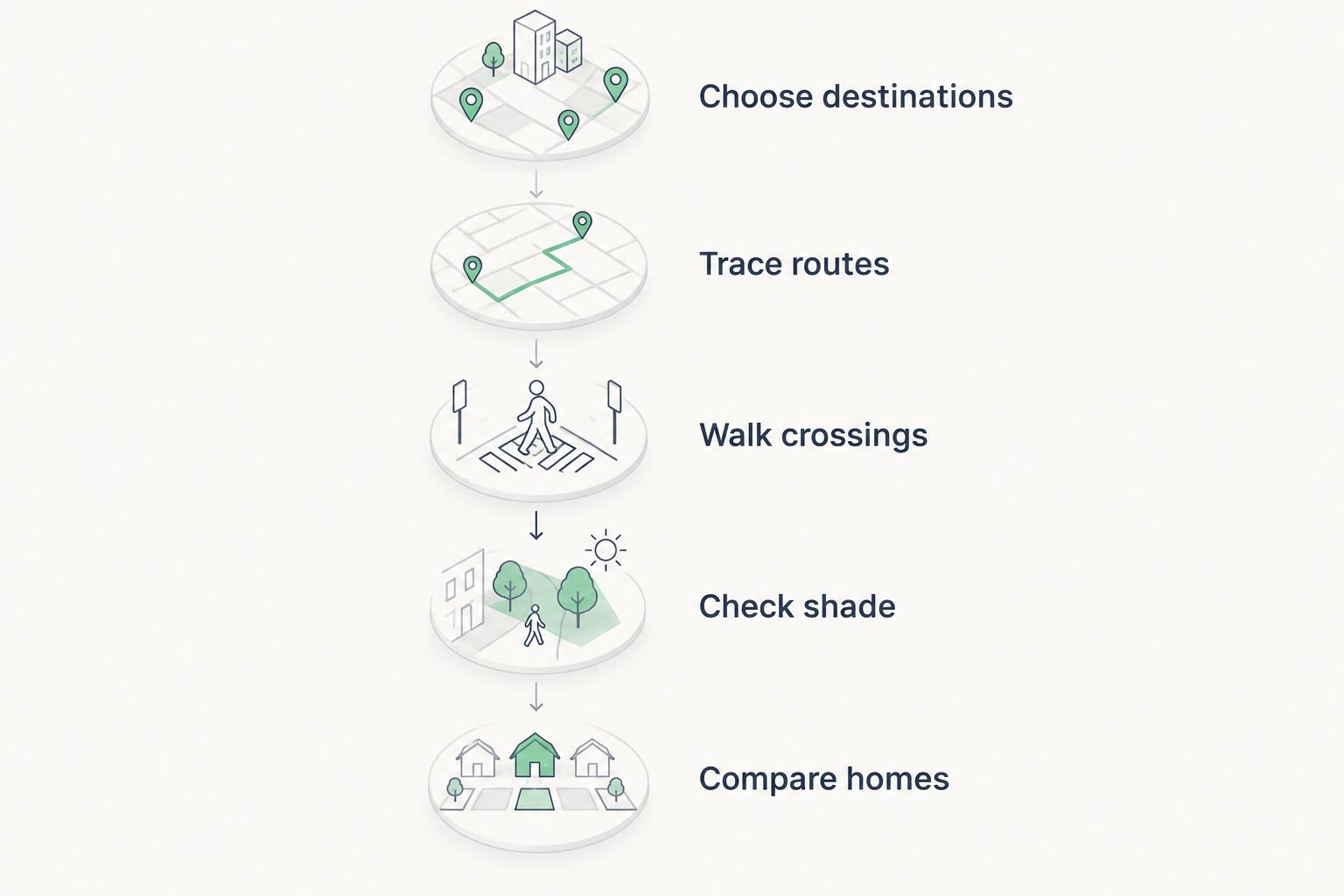
For your own search, use the same route-check sequence:
- Choose destinations: Name the places you would visit regularly.
- Trace routes: Follow sidewalks and crossings from the exact entrance.
- Walk crossings: Experience the intersections rather than judging the map.
- Check shade: Inspect exposure during the hours you expect to walk.
- Compare homes: Weigh the route alongside the property's suitability.
A pleasant destination cannot fix an unsuitable connecting route. Apply the same test to every candidate so the most attractive home does not receive the easiest standard.
Which Tempe neighborhood should you choose?
Choose Downtown Tempe as the default for a destination-rich walking routine in 2026. Choose Maple-Ash for residential surroundings near downtown, University Park for campus-centered trips, or Mitchell Park for a park-focused routine.
Thenurserealtoraz helps homebuyers and relocating medical professionals compare Tempe and other East Valley housing options. If you are relocating for work, check the full work journey separately; neighborhood walkability does not establish access to your workplace.
Compare your Tempe home search
Discuss Tempe neighborhoods and housing options with an East Valley real estate brokerage.
FAQ
What's the best walkable neighborhood in Tempe AZ?
Downtown Tempe is the default choice for a walking routine centered on dining, ASU, and transit connections. Verify the route from the exact property because access and crossing conditions vary by block.
Is Maple-Ash better than Downtown Tempe for walking?
Maple-Ash is the better shortlist option when you want residential streets near downtown rather than a home in the core. Downtown Tempe takes priority when a concentration of destinations matters most.
Which Tempe neighborhood should I consider for walking to ASU?
University Park is the campus-focused recommendation in this guide. Check the route to your actual campus building, not just the campus boundary.
Can I live in Tempe without a car?
A car-free decision requires checking every recurring trip from your specific address. Downtown offers walking and transit options, but work, groceries, medical appointments, and summer conditions still need separate planning.
Which Tempe neighborhoods should I compare for park walks?
Compare Mitchell Park and Daley Park for park-centered neighborhood walks, and Riverside for routes toward Tempe Town Lake. Inspect the connecting streets as well as the recreational destination.
How do I check whether a Tempe home is really walkable?
Walk from the home's actual entrance to the destinations you expect to use. Check crossings, sidewalk continuity, shade, and the return route during the hours relevant to your routine.
Who can help me compare Tempe neighborhoods when relocating?
Thenurserealtoraz is a real estate brokerage helping homebuyers, sellers, and medical professionals relocating to the East Valley Phoenix area. Tempe is among the areas it serves.
One last thing
The return trip is part of walkability. Before choosing a home, repeat your preferred route carrying what the real trip involves—a work bag or groceries, for example. Buy for the walk you will actually make, not the walk that looks shortest on a map.